
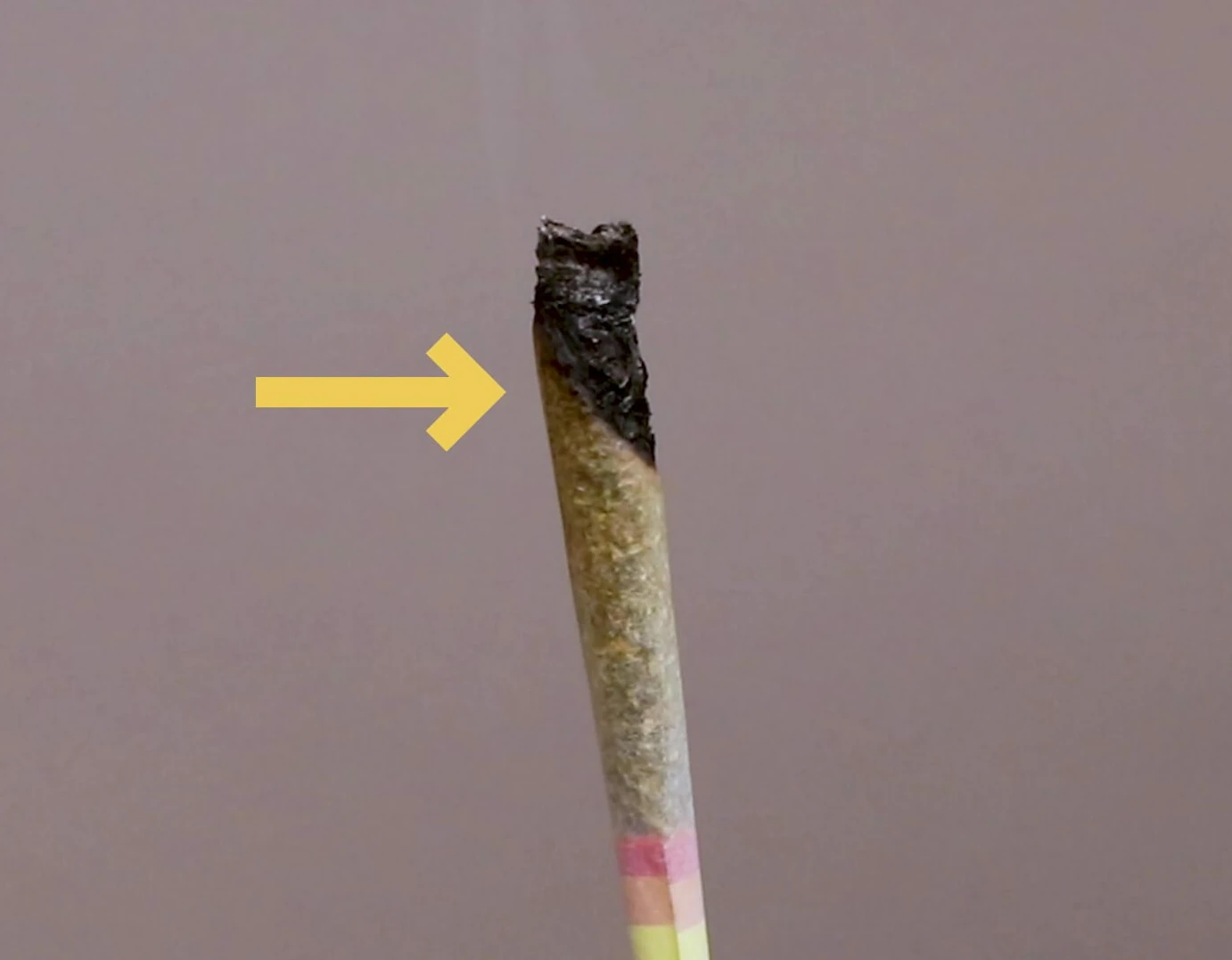
You know the moment. Half the joint has burned into a blackened trench and the other half is still sitting there green, smug, completely untouched. Congratulations — you’ve canoed it.
The usual reaction is to blame the roll. Packed unevenly. Ground too coarse. Flower too dry. And sure, sometimes that’s it. But plenty of perfectly rolled joints canoe anyway, and when they do, the culprit usually isn’t the roll at all.
It’s how you’re pulling on it.
Why a joint burns down one side
An ember can look like a clean, even disc and still be a mess up close. Burning plant material doesn’t form a smooth surface — there are microscopic gaps, uneven trichome and density variation, tiny air pockets baked into the grind. Somewhere on that burn face, one spot is always slightly more porous than the rest.
That’s all it takes, because air is lazy. It goes wherever resistance is lowest.
Here’s how a tiny flaw turns into a canoe:
- You pull hard. Incoming air doesn’t spread evenly across the cherry — it funnels through whichever micro-gap offers the easiest path.
- That channel gets a shot of oxygen. More oxygen means hotter, faster combustion in that one spot.
- The hot spot eats forward. It burns through material quicker than its neighbours, which widens the channel, which lowers resistance further, which pulls even more air.
That’s a feedback loop, and it’s fast. Two or three enthusiastic hauls is genuinely all it takes to turn a pinhole into a run down the seam that no amount of rotating will fix.
The frustrating part is that the fix and the cause are the same lever. Pull gently and the airflow stays diffuse enough that the burn line self-corrects. Pull hard and you’re actively feeding one side.
Hard pulls kill your terpenes too
Canoeing is the visible damage. The flavour damage happens at the same time, and it’s the part most people never connect back to their draw technique.
A smoldering ember sits somewhere in the neighbourhood of 500–600°C between puffs. Pull hard and you drive it up toward 800–900°C, sometimes higher. (Most published numbers here come from tobacco combustion research, but a joint and a cigarette are close enough in behaviour that the range holds.)
Now compare that to what you’re actually trying to taste. Myrcene boils at around 167°C. Limonene around 176°C. Linalool a bit under 200°C. Every terpene you care about vaporizes hundreds of degrees below the temperature of the ember itself.
Which means the good stuff never comes off the cherry. It comes off the material just ahead of the burn line, where the flower is hot enough to release aromatics but not hot enough to torch them. A gentle draw pulls that vapour forward and hands it to you intact. A hard draw drags the burn line into that zone before the vapour can escape, and you get combustion byproducts instead — hot, scratchy, generically “smoky.”
That’s why an aggressively smoked joint of good flower tastes roughly the same as an aggressively smoked joint of mediocre flower. You cooked the difference off.
| Gentle draw | Hard draw | |
|---|---|---|
| Ember temp | Roughly 500–600°C | 800°C and climbing |
| Terpenes | Vaporize ahead of the burn line and survive | Get scorched along with everything else |
| Burn behaviour | Paper watermarks can do their job | Tunneling and runs |
| Taste | Cooler, distinguishable, actually flower-specific | Harsh, flat, generic smoke |
Does the paper matter?
Some. Decent rolling papers and cones are pressed with crisscross watermark patterns, and that varying density does help regulate burn rate — it’s a real feature, not just marketing. Thinner papers (Zig Zag Silver, RAW Classic) contribute less of their own combustion to the equation, so more of what you taste is flower.
But paper is a nudge, not a defense. No watermark can out-engineer a vacuum aimed at one side of the cherry.
How to stop a joint from canoeing: 4 fixes
Sip it, don’t vacuum it. Espresso, not a thick milkshake. Gentle, measured pulls let ambient air spread across the whole face of the cherry instead of firehosing one channel. This single change fixes most canoeing on its own.
Give it 5–10 seconds between pulls. The ember needs a beat to even out across the full diameter. Chain-pulling never lets the burn line reach equilibrium, so small imbalances just compound.
Rotate it. Heat rises, so the top edge of a stationary joint runs hotter than the bottom. A slow quarter-turn between puffs cancels that out. Costs you nothing.
Touch it up early. The moment you see one edge pulling ahead, deal with it — tap off the leading ash, or hit the lagging side with a quick flame. A divot is easy to correct. A run is not. Waiting is what turns one into the other.
FAQ
Why does my joint burn faster on one side? Almost always airflow, not the roll. A hard draw funnels air through the single most porous point on the ember, which superheats that spot and makes it burn ahead of the rest. Once it starts, it feeds itself.
Can you fix a joint that’s already canoeing? A shallow one, yes. Tap the leading ash off and apply a brief flame to the side that’s lagging until it catches up, then take a much softer pull. Once the run has travelled a centimetre or more down the seam, it’s usually not recoverable — the structure is gone.
Do better rolling papers stop canoeing? They help and they don’t hurt, but they can’t fix technique. Watermarked papers regulate burn rate and thin papers add less of their own smoke, both of which give you more margin. They still can’t overcome a hard draw.
Does grind size cause uneven burning? It can. Too coarse leaves air pockets that become natural runaway channels; too fine restricts airflow and encourages you to pull harder, which causes the same problem from the other direction. A medium, consistent grind gives you the widest margin for error.
How long should you wait between puffs? Five to ten seconds is plenty. You’re just giving the combustion zone time to level out across the full diameter before you add more oxygen.
The short version
Pre-rolls want steady, low-velocity airflow. That’s basically the whole thing.
Slow down and the paper and the flower handle the rest on their own — flatter burn, cooler smoke, and a joint that actually tastes like the strain you paid for, all the way to the roach.